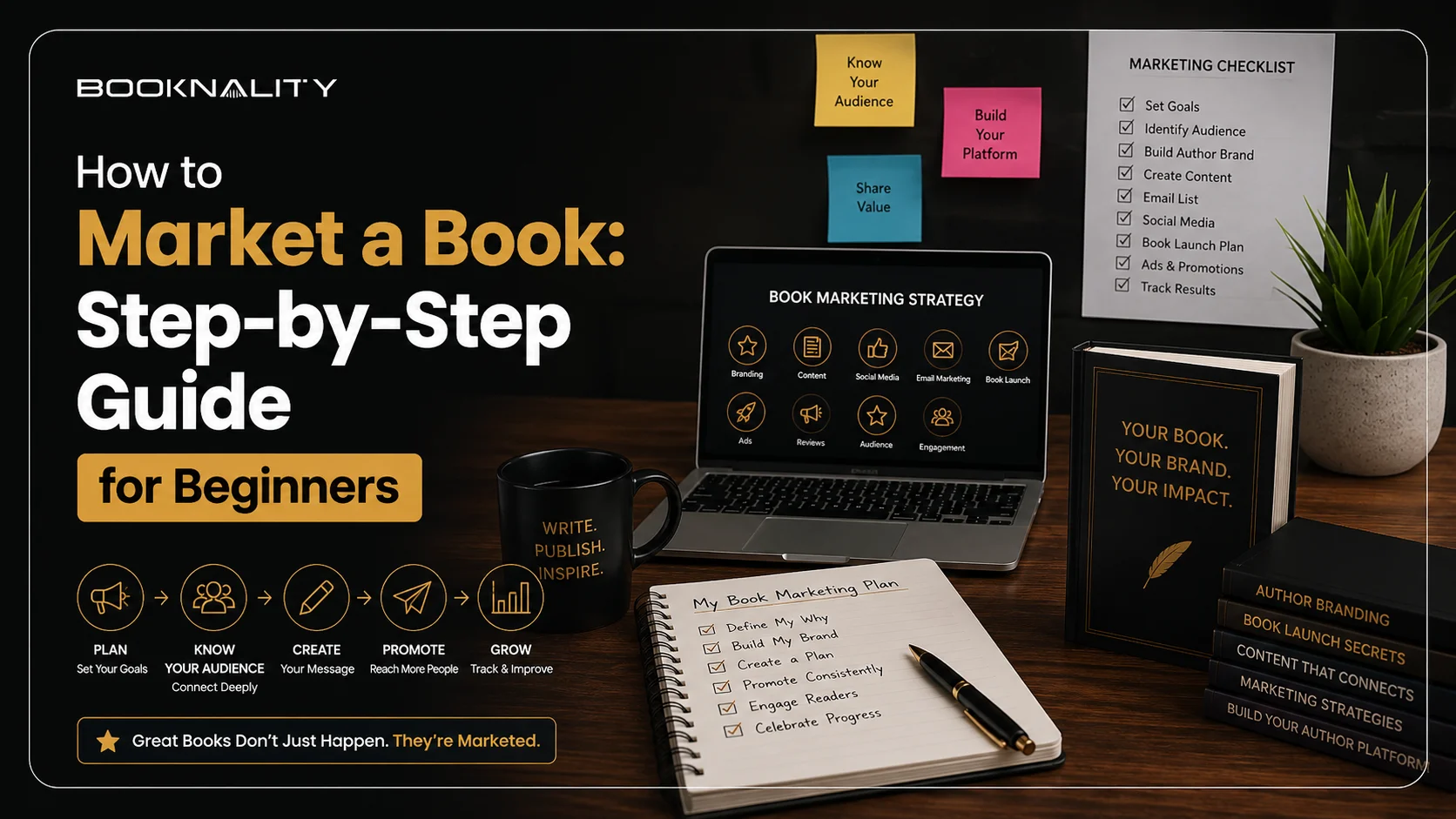

You finished writing your book. That alone is something most people never do. But now you’re staring at a published title, or one that’s almost ready, and wondering: how do I actually get people to read this?
Learning how to market your book online can feel overwhelming, especially if you’ve never done it before. There’s no shortage of advice out there, and a lot of it contradicts itself. Some people swear by social media. Others say email lists are everything. Some push paid ads from day one, while others insist organic content is the only way.
Here’s the truth: there’s no single formula that works for every book or every author. But there is a logical, step-by-step approach that gives your book the best possible chance of finding its readers, without burning you out or breaking your budget in the process.
This guide is for authors who are starting from scratch. Whether you’re self-published or working with a publishing partner, these steps will help you build a real marketing foundation for your book and understand how to market a book in a way that feels manageable.
Step 1: Get Clear on Who Your Reader Is
Before you spend a single dollar or write a single social media post, you need to know who you’re trying to reach.
This sounds obvious, but many authors skip this step. They say things like “my book is for everyone” or “anyone who likes reading would enjoy it.” That’s not a marketing strategy; that’s a recipe for being invisible.
Ask yourself these questions:
- Who has the problem my book solves, or who would find the most joy in my story?
- How old are they? What do they care about?
- Where do they spend their time online?
- What books have they already read and loved?
- What would make them pick up my book over a dozen others?
Once you have a clear picture of your ideal reader, every marketing decision becomes easier. You’ll know which platforms to focus on, what kind of content to create, and how to talk about your book in a way that actually resonates.
Step 2: Build Your Author Platform Before You Need It
One of the biggest mistakes new authors make is waiting until the book is published to start building an audience. By then, you’re starting from zero at the exact moment you need momentum.
Your author platform is simply the combination of spaces where readers can find you, follow you, and connect with you. This includes:
An Author Website
Your website is your home base. It’s the one place you own completely, unlike social media platforms that can change their algorithms overnight. A good author website should include your bio, your book (or upcoming book), a way for people to join your email list, and ideally a blog or resources section that gives readers a reason to visit.
An Email List
Email remains one of the most effective marketing channels for authors. People on your list have actively chosen to hear from you. When your book launches, these are the people most likely to buy it, review it, and tell their friends.
Social Media Presence
You don’t need to be on every platform. Pick one or two where your readers actually spend time and show up there consistently. For nonfiction and business books, LinkedIn and Instagram tend to work well. For fiction, Instagram, TikTok (BookTok), and Facebook reader groups are often more effective.
If building an author website feels like too much to handle alongside everything else, that’s something a professional publishing partner can help you set up properly from the start.
Step 3: Write a Book Description That Actually Sells
Your book description, whether it lives on Amazon, your website, or a retailer’s page, is one of your most important marketing tools. It’s often the last thing standing between a browser and a buyer.
A weak book description sounds like a summary. A strong one sounds like a reason to read.
If you’re trying to understand how to promote your book effectively, start by looking closely at the way you present it. A great book can be overlooked when its description is vague, confusing, or too focused on explaining the writing process instead of showing readers why the book matters to them.
For nonfiction
A strong description can:
- Open with the problem or promise
- Show what the reader will gain
- Establish your credibility
- Explain what makes the book useful or different
- Close with a clear, confident reason to read
For fiction
The approach is slightly different:
- Open with a hook or compelling character situation
- Build tension or intrigue
- Give readers a sense of the stakes
- Introduce the central conflict
- End with a question or line that creates curiosity
Spend real time on this. Rewrite it. Test it. Read it aloud. If it doesn’t make you want to read the book, it won’t make anyone else want to either.
Your description does not need to explain everything. In fact, it shouldn’t. Its job is to create enough interest for the reader to take the next step.
Step 4: Understand How to Market Your Book Online
Knowing how to market your book online starts with understanding that online marketing is not one thing; it’s a collection of channels, each with its own rules and strengths.
Here’s a breakdown of the main ones:
Channel |
Best For |
Effort Level |
| Amazon optimization | Discoverability and conversions | Medium |
| Social media content | Audience building and engagement | High |
| Email marketing | Direct sales and loyalty | Medium |
| Book blogs and review sites | Credibility and reach | Low-Medium |
| Paid advertising | Scaling what’s already working | High |
| Podcast appearances | Authority and new audiences | Medium |
You don’t need to master all of these at once. Start with two or three. Get consistent with those before adding more.
Amazon optimization deserves special mention because it’s often overlooked by new authors. Your book’s Amazon page is essentially a landing page, and small improvements to your title, subtitle, keywords, categories, and description can meaningfully increase how often it appears in searches and how often browsers convert into buyers.
Step 5: Get Reviews Early and Strategically
Reviews are social proof. For a new author, it’s also one of the hardest things to get.
Here’s how to build them intentionally:
Before launch: Identify advance readers, people in your network, beta readers, or members of your target audience, and send them a copy early in exchange for an honest review on launch day.
At launch: Make it easy for early buyers to leave a review. A simple follow-up note or email with a direct link to the review page removes friction.
Ongoing: Don’t stop asking. Every reader who tells you they loved the book is someone who could be leaving a review instead.
Reviews on Amazon and Goodreads carry the most weight for discoverability and credibility. Even ten or fifteen genuine reviews can make a meaningful difference.
Step 6: Create Content That Connects to Your Book
One of the most underused strategies for how to promote your book is content marketing, creating articles, posts, videos, or other content related to your book’s topic or themes.
If you wrote a business book, write LinkedIn articles about the ideas in it. If you wrote a memoir about overcoming a challenge, share shorter reflections on that journey. If you wrote a children’s book, create content for the parents who buy it.
This kind of content does two things:
- It builds an audience of people who are already interested in what your book is about
- It positions you as a knowledgeable, credible author, not just someone trying to sell a book
The goal isn’t to give away the entire book. It’s to give people a reason to trust you and want more.
Step 7: Build a Simple Launch Plan
You don’t need a complex, multi-month campaign for your first launch. You need a clear, focused plan you can actually execute.
A basic launch plan for a new author might look like this:
4–6 weeks before launch:
- Finalize your book description and Amazon page
- Set up or update your author website
- Grow your email list by talking about the upcoming release
- Reach out to advance readers for early reviews
1–2 weeks before launch:
- Send email announcements to your list
- Post consistently on your chosen social platforms
- Reach out to any bloggers, podcasters, or communities in your niche
Launch week:
- Announce across all your channels
- Email your list
- Share the book in relevant online communities (without spamming)
- Encourage early buyers to leave reviews
Post-launch:
- Continue creating content
- Follow up with readers
- Look at what worked and what didn’t
Marketing doesn’t stop at launch. The authors who build lasting readership are the ones who stay consistent long after the initial excitement fades.
Step 8: Don’t Try to Do Everything Alone
Book marketing is a real discipline. It takes time, strategy, and a lot of consistent effort. Most authors, especially those balancing a career, a business, or a family, find it nearly impossible to handle writing, publishing, and marketing simultaneously at a high level.
That’s not a failure of ambition. It’s just reality.
Working with a professional team that understands both publishing and marketing means you get expert support without having to figure everything out yourself. From book marketing services to social media management and even building your author website, having the right people in your corner makes the process significantly less stressful and significantly more effective.
Final Words
Marketing your book doesn’t have to feel like a second job you never signed up for. When you approach it step by step, starting with your reader, building your platform, crafting a strong description, and creating a focused launch plan, the process becomes much more manageable.
The most important thing is to start. Not when everything is perfect, not when you feel completely ready, but as soon as you have a clear direction and a strategy you can realistically maintain.
If you’re still wondering how to market your book online, remember that you do not need to be everywhere at once. A strong website, a clear understanding of your audience, consistent content, and a few well-chosen marketing channels can give you a much stronger foundation than trying to follow every trend.
The same applies when you’re learning how to market a book for the first time. You will learn more by testing, reviewing your results, and improving your approach than by waiting for the perfect strategy to appear.
If you’d like help building a marketing strategy that actually fits your book and your life, Booknality’s book marketing team is here to support you, not replace your voice, but amplify it.